

Improve, preserve, secure

Why Post-Tensioning Systems Inspection Matters

Older post-tensioning systems often use materials, installation details, grouting practices, and corrosion protection measures that differ significantly from today’s construction standards. Proper evaluation requires engineers who understand these legacy conditions as well as the underlying mechanics of prestressing

When older post-tensioning systems are evaluated, the assessment check for the presence of residual prestress forces and aim to detect serious issues like grout voids, soft grout, hardware failure, water ingress, chloride contamination, concrete damage (cracks, spalls, delaminations) and tendon corrosion, providing a thorough evaluation beyond simple visual checks. At Freyssinet, we pair destructive inspection and non-destructive (NDT), and advanced diagnostics when possible (endoscopy, E-scan, cross bow, and acoustic monitoring) with in-house engineering to turn analysis findings into effective and economical remediation plans.
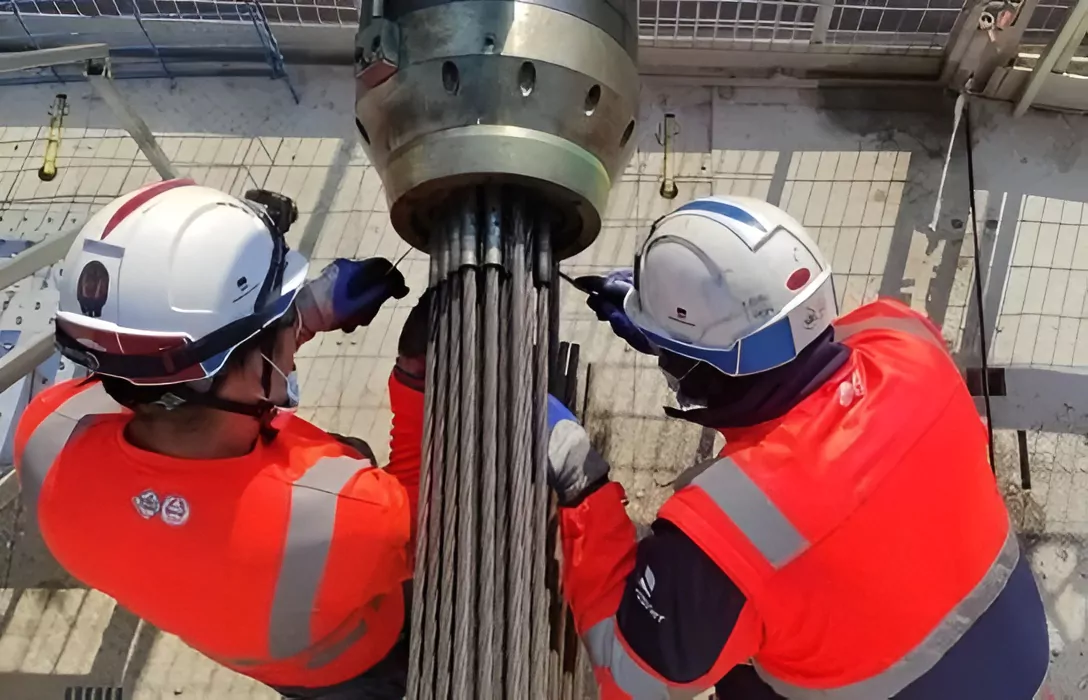
Post-Tensioning Systems Inspection: What It Detects?

The performance of a prestressed structure depends heavily on its post-tensioning systems – from slabs and beams in parking garages and buildings to bridge decks and segmental structures. Comprehensive post-tensioning inspections help owners to verify that prestress forces remain effective and that tendons or cables are adequately protected. Early detection is key to mitigating damage, repair costs and durations when asset serviceability is compromised.

In commercial and infrastructure projects, external post-tension steel cables, particularly in prefabricated bridge segments, are a key concern. Freyssinet provides targeted diagnostics and engineering analysis to identify concerns and plan durable repair strategies. Routine inspections of ducts, anchorage zones, and tendon high points may reveal grout voids, moisture infiltration, and chloride contamination which can accelerate tendon corrosion from surface rust to section loss and full strand failure.

Voids are occasionally detected at high points in the post-tensioned cable profile, where tendons, improperly vented during grouting, are left with steel exposed to air and moisture. These voids reduce post-tensioning corrosion protection, creating corrosive environments that require precise location and grout re-injection.

Bleed water trapped during grout curing or water entering through leaks can accumulate inside ducts and anchorage areas of post-tensioned slabs or beams. Without proper sealing or drainage, persistent moisture ingress may initiate and sustain tendon or cable corrosion over time, potentially compromising structural integrity. Engineered remediation strategies help prevent tendon failure and preserve long-term performance.

Corrosion progresses along post-tension cables from minor surface rust to section loss and wire fracture. In older post-tensioned structures built with less resistant steel, stress cracking and strand breakage are additional failure risks that require early detection and engineered remediation.

Inspecting and Assessing Post-Tensioning Systems

Post-tensioning systems in parking structures, bridge decks, and other prestressed concrete elements require specialized inspection and maintenance to extend tendon service life, including emergency response when a cable breaks or load-bearing capacity is uncertain.

The initial focus of an emergency response is to determine if the asset is safe to remain in-service as-is or should be shut down to determine immediate actions to avoid further damage/failure are necessary. Further analysis may be needed to make this determination. Projects are planned to meet milestones while minimizing disruption to operations and traffic.

Why Choose Freyssinet for Inspecting Your Post-Tensioning Systems?

01. Expert Analysis of Structural Defects

With decades of experience in post-tensioning inspection, we provide detailed assessments to identify structural defects and evaluate tendon performance. Our team helps owners and engineers understand tendon conditions and predict how prestressing forces may evolve over time.

02. Customized Inspection and Monitoring Programs

We develop inspection and monitoring plans tailored to each structure’s configuration. These programs combine visual surveys, instrumentation, and advanced diagnostics to ensure early detection of grout voids, moisture ingress, chloride contamination, and tendon corrosion.

03. Targeted Diagnostic Testing and Structural Studies

Our team conducts specialized destructive and non-destructive testing and field diagnostics to inspect for corrosion, detect strand breakage, and assess structural response. This ensures interventions are precise, effective, and maintain structural integrity.

04. From Inspection Findings to Proven Strengthening Solutions

We apply targeted remediation based on inspection results: void reinjection, detensioning, tendon strengthening or replacement, provide additional post-tensioning, epoxy crack injection, carbon fiber reinforcement, chloride extraction, shotcrete, cathodic protection and corrosion protection. Each strategy is purposefully selected to restore structural safety and extend service life.

Our Post-Tensioning Inspection Process

Evaluation of Tendon and Anchorage Conditions

Our inspection process targets steel tendons, concrete elements, and anchorage zones. Visual surveys and advanced diagnostics identify grout voids, corrosion, and force loss. The results provide a clear baseline of tendon condition and structural performance.
  • Visual inspection of anchor heads to identify wear, cracks, or hairline cracks
  • Ultrasonic testing to assess corrosion, plus sonic and electromagnetic testing, based on the right test method for the tendon configuration
  • Endoscopic inspection along identified injection voids, and X-ray/gamma radiography to assess grout fill and voids in internal prestressing.

Tendon Acoustic Monitoring

For tendons at risk of wire breakage or corrosion-related failure, we deploy acoustic monitoring systems. These allow real-time detection of strand breaks and track their progression, providing critical information for maintenance planning and service level decisions.
  • Detection and location of wire break events using acoustic sensors
  • Real-time alerts for immediate awareness
  • Data interpretation to support remediation strategy

Inspection Team Safety in Confined and High-Risk Environments

Working in confined spaces or on live tendons requires strict safety protocols. We assist clients in implementing protective measures to safeguard crews during inspections, ensuring compliance with industry safety standards.
  • Traffic management or access restrictions to maintain safe work zones
  • Safety plans and energy containment measures for live tendons
  • Protective systems for confined-space inspections

Corrosion Protection Assessment and Retrofitting

Older post-tensioning systems may have loose sheaths, components with low-quality grout, or outdated materials that leave tendons exposed. Freyssinet provides targeted solutions to restore protection, verify compliance with original design specifications, and extend service life.
  • Vacuum re-injection of grout voids in tendons
  • Restoration of duct and anchorage watertightness
  • Removal of deteriorated or low-quality grout where feasible

Cross-Bow Testing and Force Verification

To verify residual tendon forces and detect prestress loss, we use cross-bow testing along with other force measurement techniques. These methods ensure that structural capacity is maintained and inform any necessary strengthening or replacement interventions.
  • Cross-bow measurements to assess tendon tension
  • Vibrating wire force measurement and cross-bow testing to verify residual force
  • Integration of results into engineered maintenance plans

Discover Our Projects

Contact Freyssinet Today!

Thank you for your interest in Freyssinet, Inc. To discuss a specific project, sign up for our newsletter, schedule a presentation, or request other information, please fill out the form below and we will contact you shortly.

  • This field is for validation purposes and should be left unchanged.
  • *Mandatory fields