How Does Post-Tensioning Work?
What Is Post-Tensioning and Why Does It Matter?
Post-tensioning is a prestressed concrete technique where high-strength steel tendons are stressed after the surrounding concrete has hardened and reached sufficient strength. The method pre-compresses the concrete member, placing it under permanent compressive stress that directly counteracts the tension forces generated by structural loads, dead weight, and environmental conditions.
This distinction matters because concrete performs well under compression but fails under tension.
A reinforced concrete slab with passive rebar only engages its steel reinforcement after cracks have already formed, meaning the damage precedes the response.
Post-tensioning reverses that sequence: the system applies active compressive force before any load arrives, so the concrete never reaches its tensile limit under normal service conditions.
The technique traces back to Eugène Freyssinet, who patented prestressing in 1928. His design principle, compressing concrete in advance to eliminate tensile failure, remains the foundation of every modern post-tensioning method used in bridges, buildings, and infrastructure worldwide.
How Does Post-Tensioning Differ From Pre-Tensioning?
Both methods fall under prestressed concrete, but the process and application differ significantly.
Pre-tensioning stretches steel strands in a casting bed before the concrete is poured. Once the concrete cures and bonds to the strands, the tension is released, transferring compressive force into the hardened member.
This method works best for repetitive, factory-produced elements like precast beams, hollow-core slab panels, and double-tee sections where standardized molds justify the setup.
Post-tensioning follows the opposite sequence. Steel tendons are placed inside ducts within the formwork, the concrete is poured around them, and stressing happens on-site after the reinforced member reaches target strength. This system accommodates custom geometries, curved tendon profiles, and cast-in-place construction where every span or slab may have a different shape or loading requirement.
The practical split is straightforward: pre-tensioning suits high-volume precast production, post-tensioning suits complex, site-built structures.
Why Choose Post-Tensioning Over Traditional Rebar?
Passive rebar sits dormant inside concrete until cracks form and the steel finally engages. By that point, the damage is already visible and the member has lost stiffness. Post-tensioning eliminates that gap by applying compressive reinforcement before the structure takes any load, which is why PT slabs resist cracking under spans and conditions where traditional rebar alone would fail.
The two reinforcing approaches aren’t mutually exclusive. Post-tensioned members still use conventional rebar around anchorage zones, at slab edges, and in areas of high local stress.
The rebar handles concentrated forces while the tendons manage the global compression. Their combined strength produces a member that controls both service-load cracking and ultimate capacity better than either system on its own.
Active reinforcement doesn’t happen by accident, it follows a precise multi-step process from tendon layout through final stressing.
How Does the Post-Tensioning Process Work?
The post-tensioning process follows a fixed sequence: tendons are placed inside ducts, concrete is poured around the assembly, the concrete cures to target strength, and hydraulic jacks apply tension to the cables.
Each step builds on the previous one, using precise engineering controls to produce the final compressive force in the system.
Skipping or misordering any stage compromises the tensioning outcome and the structural integrity of the member.
How Are Tendon Layouts Designed and Planned?
Engineers determine the number of tendons, their spacing, and the force each strand must carry based on the structural loads the member will support.
Tendon profiles aren’t straight: they follow a curved, draped path that sits high near the supports and dips low at midspan, mirroring the bending moment diagram of the slab or beam.
This design technique places compressive force exactly where tension would otherwise concentrate.
Spacing depends on the application. Residential slabs typically use tendons at 48 in. on center, a system that balances material cost against performance for lighter loads. Commercial and infrastructure projects demand denser layouts, with tighter spacing and higher strand counts to handle heavier spans and more complex load paths.
Placement of Post-Tensioning Tendons and Ducts
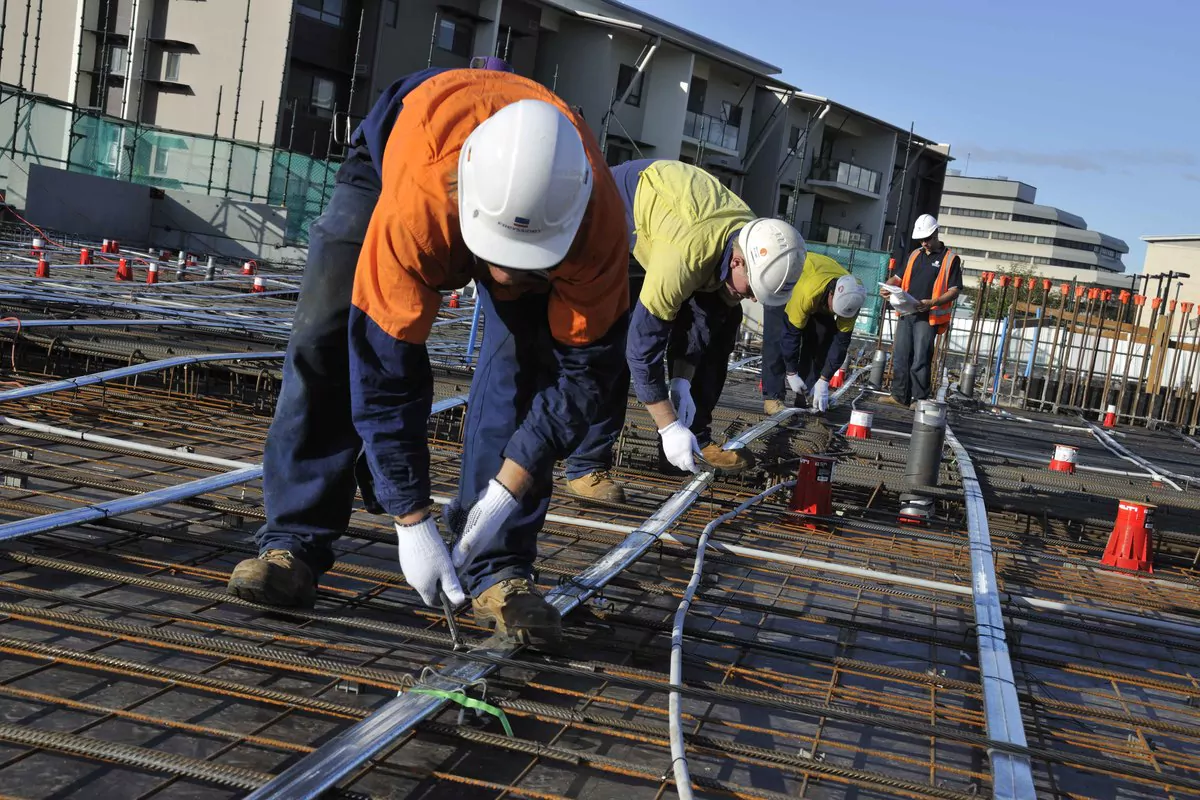
Each tendon consists of 7 high-strength steel wires twisted into a single strand, and multiple strands are grouped into cables sized to the project’s force requirements.
The strands are placed inside plastic or metal ducts that have been secured to the formwork before the pour. Chairs and supports hold the ducts at the correct elevation so the curved profile established during design stays intact once the concrete is poured around them.
Anchorage hardware is embedded in pockets at the slab edge or beam end, giving the hydraulic jacks a bearing surface for stressing.
The ducts themselves must remain sealed at every joint to prevent wet concrete from entering and blocking the tendon path. A blocked duct means the strand can’t move freely during stressing, which compromises the force transfer and the overall strength of the finished member.
Concrete Pouring and Curing
Once the ducts and anchorage hardware are in position, concrete is poured around the entire tendon assembly. The mix design varies by application: a typical residential slab uses an 8 in. thick pour at 3,000 psi, while commercial and bridge members call for higher-strength material and deeper cross-sections.
The concrete must reach a minimum compressive strength of 2,000 psi before the stressing process can begin, and the time required ranges from 3 to 10 days depending on the mix, ambient temperature, and curing conditions. Stressing too early risks crushing the concrete around the anchorage zones, so the reinforced member’s strength gain is monitored with field-cured test cylinders throughout the curing period.
Stressing Post-Tensioning Tendons With Hydraulic Jacks
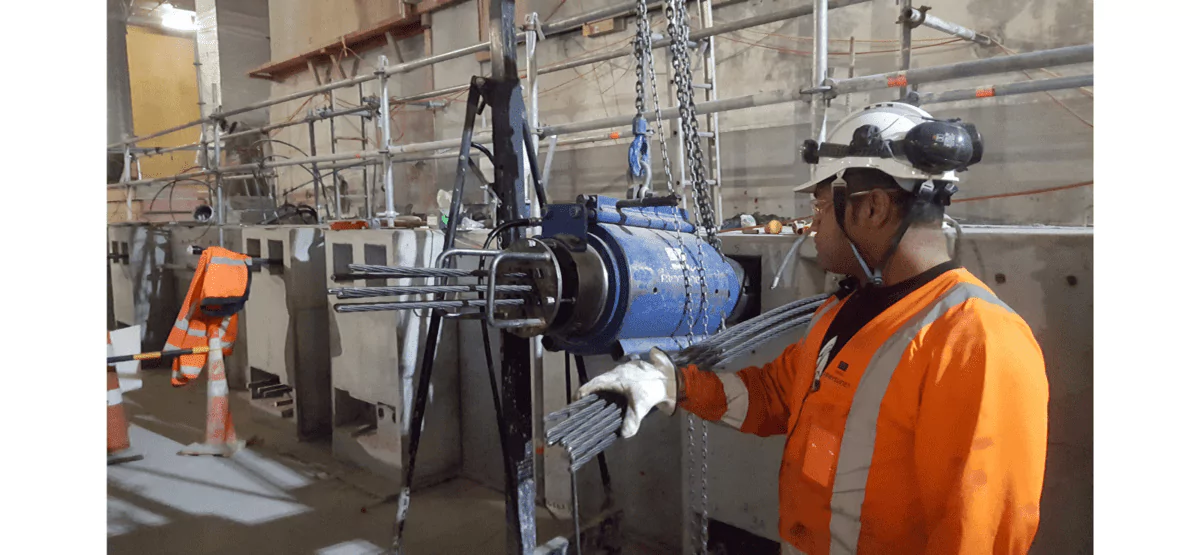
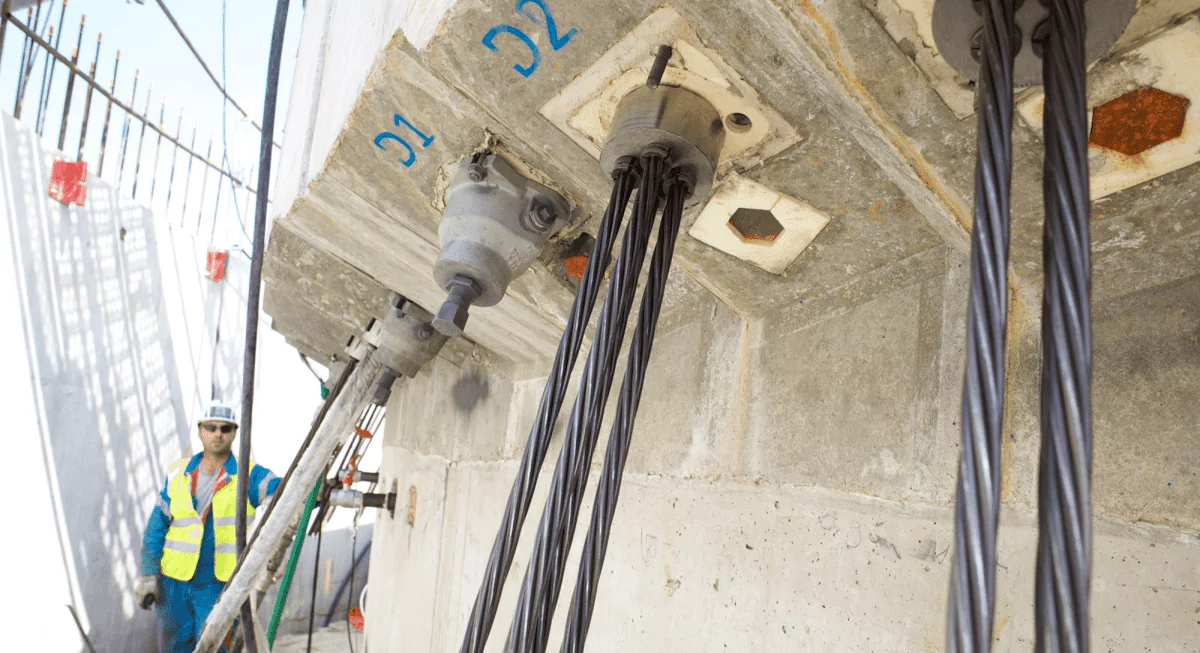
Once the concrete reaches its required strength, hydraulic jacks are fitted to the anchorage ends and used to pull each tendon to the specified force. A single seven-wire strand carries approximately 33,000 lbs of tensioning force and stretches roughly 4 in. per 50 ft of length. The elongation is measured at each end and compared to calculated values: if the numbers match within tolerance, the tension in the strand is confirmed.
This verification process is the primary quality control step for the entire post-tensioning system. A strand that falls short on elongation may indicate a blocked duct, friction loss, or improper seating at the anchorage. Crews resolve the discrepancy before moving to the next strand, because under-stressed tendons reduce the load capacity of the finished member.
Safety during stressing is governed by OSHA 1926.701(c), which requires exclusion zones behind the jacks, physical barriers, and visible signage. A high-energy tendon release during stressing is a serious hazard, and no personnel are permitted in the line of force while the jacks are under pressure.
Anchoring and Grouting Post-Tensioning Tendons
After each tendon reaches its target force, the strand is locked into the anchorage hardware using wedges that grip the steel under load. The excess strand extending past the anchor is cut, and the recessed pocket is filled with a protective material, typically cementitious grout or an epoxy cap, to seal the anchorage against moisture and corrosion.
What happens inside the duct from this point forward depends on the system type.
In bonded post-tensioning, the entire duct is injected with cementitious grout that hardens around the tendon, locking it to the surrounding concrete along its full length. This creates continuous reinforcing action: if one strand loses force at a single point, the grouted bond redistributes the load to adjacent sections within the member.
In unbonded systems, the tendon remains free to move inside a grease-filled plastic sheath, and no grouting takes place along the duct.
The overall force still transfers through the anchorages at each end, but the tendon and the concrete act independently between those points.
This distinction between bonded and unbonded behavior shapes every downstream decision about inspection, maintenance, and structural form.
What Are Bonded and Unbonded Post-Tensioning Systems?
The two primary types of post-tensioning systems, bonded and unbonded, share the same reinforcement principle but differ in how the tendon interacts with the surrounding concrete after stressing.
That single design choice determines the structural behavior of the member under load, the technique used for corrosion protection, and the method required for future inspection or repair.
Understanding the difference matters because it affects crack control, redundancy, and long-term maintenance for every post-tensioned member.
What Are Bonded Post-Tensioning Systems?
In a bonded system, the steel tendons are grouted inside their ducts after stressing is complete. The cementitious grout hardens and locks the tendon to the surrounding concrete along the full length of the member, creating a composite reinforcement section where the tendon and the structure act as one unit under load.
This bond provides two structural advantages. First, if a tendon loses force at a single point because of damage or corrosion, the grouted connection redistributes that force to adjacent sections rather than releasing it entirely. Second, bonded tendons distribute crack widths more evenly across the member, which limits the size of any individual crack under heavy loading.
Bonded systems are standard in bridge construction, segmental box girders, and large civil structures where redundancy and durability under sustained heavy loads outweigh the added complexity of duct grouting.
Where Are Unbonded Systems Commonly Used?
Unbonded tendons are coated in corrosion-inhibiting grease and enclosed within a plastic sheath, allowing the strand to move freely inside the duct. This technique simplifies installation because it eliminates the grouting step entirely, reducing labor and equipment on site.
The practical result is a lighter, faster system that dominates building construction in the United States. Roughly 95% of domestic post-tensioning production uses unbonded single-strand tendons, and the applications reflect that volume: cast-in-place floor slabs, parking structures, slab-on-grade foundations, and mid-rise buildings where thinner slab profiles and open floor plans drive the design. Within these structures, unbonded tendons keep member depths low enough to add usable floors without increasing the overall building envelope.
Both system types solve the same core problem, but their long-term performance depends on inspection schedules and how well the reinforcement is maintained against corrosion and force loss over time.
Does Post-Tensioning Require Inspection and Maintenance?
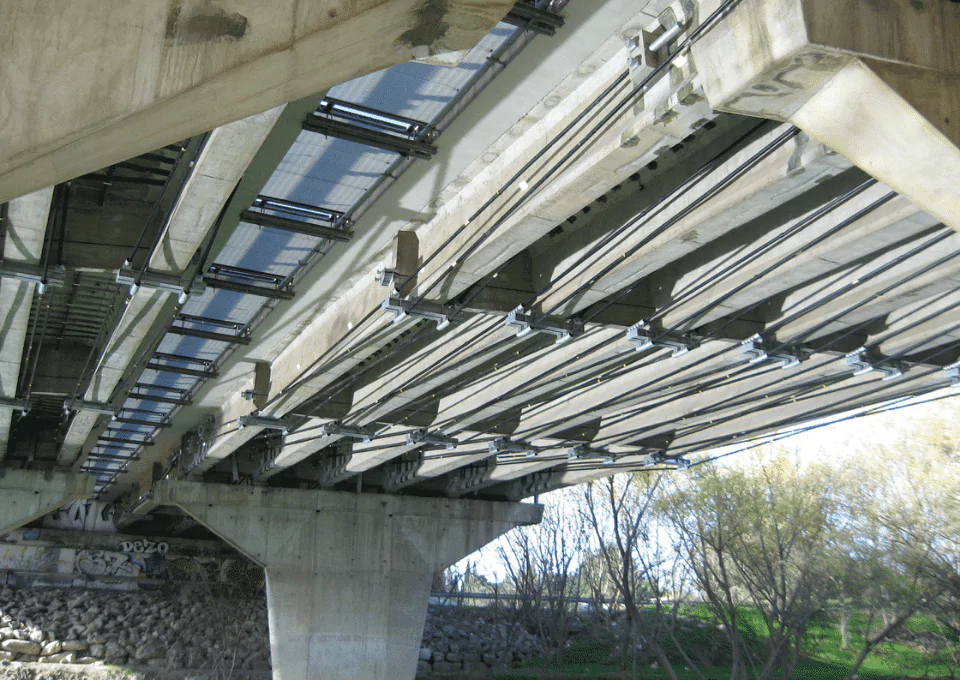
Post-tensioned structures are designed for long service lives, but the reinforcement system inside them is not maintenance-free. Tendons, anchorages, and grout all degrade over time when exposed to moisture, chlorides, or structural overloads, and the consequences of undetected tendon failure are more severe than in conventional rebar construction because each strand carries a much higher concentrated force. Routine inspection and proactive maintenance of post-tensioning tendons are what separate structures that reach their full design life from those that require early, costly intervention.
Post-Tensioning Tendon Inspection Methods
Inspection of post-tensioned members starts with a visual survey of the concrete surface, anchorage zones, and any exposed hardware. Corrosion staining, unexpected cracking patterns, and spalling near anchor pockets are the earliest visible indicators that something within the reinforcement system may be compromised.
When surface inspection alone is not enough, non-destructive testing methods provide data on what is happening inside the structure.
Ground-penetrating radar (GPR) locates tendon positions and identifies voids in grouted ducts. Impact-echo testing detects delaminations and grout deficiencies along the tendon path.
Force verification, typically performed by lift-off testing at the anchorage, confirms whether a tendon still carries its design load.
These inspections require qualified personnel with specific post-tensioning expertise, and they follow scheduled intervals that vary by structure type, exposure conditions, and the age of the system.
When Does Post-Tensioning Repair Become Necessary?
Repair becomes necessary when inspection reveals conditions that compromise the structural capacity of the reinforcement system. The most common triggers are tendon corrosion, anchorage failure, grout voids in bonded ducts, and accidental tendon cuts from coring or drilling operations that were not coordinated with the tendon layout.
The warning signs are often visible before a full failure occurs. Rust staining on the concrete surface near anchorage zones, new cracking patterns that don’t align with expected load paths, and measurable force loss during lift-off testing all indicate that one or more tendons need attention. Left unaddressed, these conditions accelerate: a single corroded tendon transfers its load to adjacent strands, increasing stress on the remaining reinforcement and widening the cracking that triggered the inspection in the first place.
Post-tensioning repair is specialized work that requires contractors with direct PT experience, proper stressing equipment, and familiarity with the specific system type installed in the structure. The questions below address the most common concerns owners, engineers, and contractors raise about post-tensioned construction.
Frequently Asked Questions About Post-Tensioning
What Is the Difference Between Post-Tensioning and Prestressing?
Prestressing is the umbrella term for any technique that introduces compressive stress into a concrete member before it carries external loads, with post-tensioning (tendons stressed after concrete hardens) and pre-tensioning (strands stressed before pouring) as the two methods. Every post-tensioned system is prestressed, but not every prestressed system uses the post-tensioning process.
How Long Do Post-Tensioned Structures Last?
With proper design, quality corrosion protection, and scheduled inspection, post-tensioned structures routinely achieve service lives of 75 to 100 years or more. The overall lifespan depends on exposure conditions, grouting quality in bonded ducts, and whether structural maintenance is performed at the intervals recommended by the engineer of record.
Can Post-Tensioned Concrete Be Cut or Drilled?
Cutting or coring is possible only in pre-planned zones where the tendon layout has been mapped and verified, because accidentally severing a single strand releases tens of thousands of pounds of stored energy and creates an immediate structural and safety hazard. Ground-penetrating radar scanning is required before any penetration, and all openings must be coordinated with the original reinforcing drawings from the design phase.
Is Post-Tensioning More Expensive Than Traditional Reinforcement?
The upfront material and labor costs for post-tensioning are higher than for traditional rebar installation, but overall project economics typically favor PT because thinner slabs require less concrete, fewer columns reduce foundation costs, and faster timelines lower general conditions expenses. The design also allows longer spans with less total steel, and post-tensioning systems use 20 to 30% less embodied carbon than conventional reinforced concrete alternatives, a material efficiency gain that further reduces transportation and production costs.
What Safety Precautions Apply During Post-Tensioning Operations?
OSHA 1926.701(c) requires exclusion zones behind the hydraulic jacks, physical barriers, and visible signage during every stressing operation, and only PTI-certified personnel should perform the work using calibrated equipment and elongation verification procedures. The need for specialized crews and precision tooling means post-tensioning operations require more planning and coordination than standard rebar placement.
What Is the Minimum Concrete Strength Required Before Stressing?
The concrete must reach a minimum compressive strength of 2,000 psi before any tendon stressing begins, a threshold that takes 3 to 10 days depending on the mix design and ambient conditions. Field-cured test cylinders are used to verify strength gain before crews proceed with the hydraulic jacking sequence.
How Does Post-Tensioning Reduce a Building’s Carbon Footprint?
Post-tensioned structures use less concrete and steel than conventionally reinforced alternatives because thinner slabs and longer spans reduce the total volume of material required. This translates to 20 to 30% lower embodied carbon per structure, along with reduced transportation emissions from smaller material quantities delivered to the site.
What Happens if a Post-Tensioning Tendon Fails?
A single tendon failure redistributes its load to the remaining strands in the member, increasing stress on the adjacent reinforcement and widening existing cracks. In bonded systems the grouted connection limits force loss to the immediate area of damage, while in unbonded systems force loss affects the full tendon length between anchorages, which can have a more significant impact on the member’s structural capacity.